1. Home
  2. Instruments
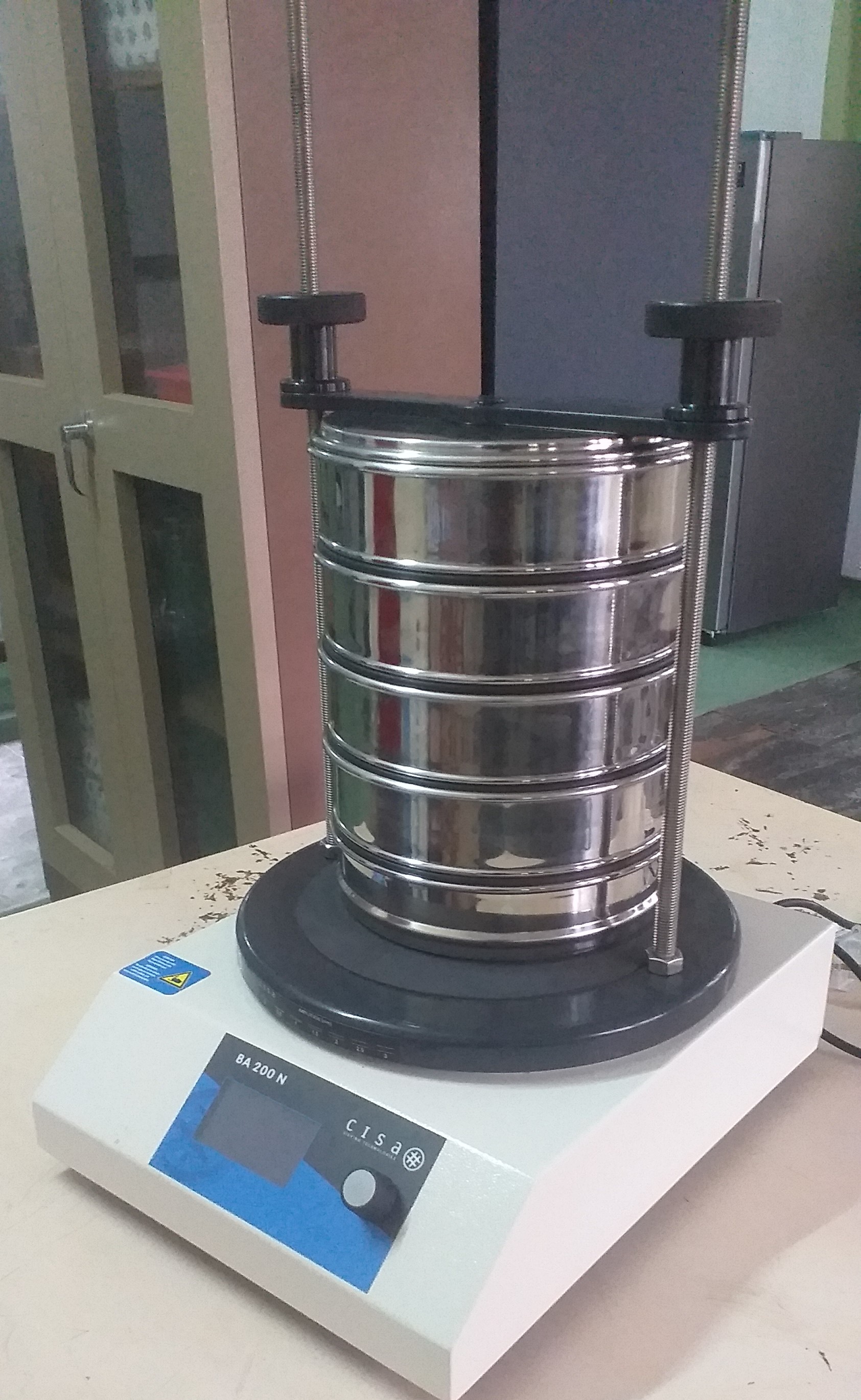
  3. Sieve Shaker

About This Instrument

Analysis of Particle size distribution. Solid/ Liquid materials can be sieved through standard test sieves stack with mesh sizes 2, 1, 0.5, 0.25, 0.125 and 0.063 mm

Functioning well

Sieve Shaker

Rajarata University of Sri Lanka
  •   Faculty Agriculture
  •   Department Agricultural Systems
  •   Laboratory Agroecology Laboratory
  •   Category Particle Size Analysis
  •   Sub Category Dry sieving, Wet sieving
  •   Keywords Particle size distribution, Sieve analysis, test sieves
Service Charge Contact Institute

Manufacturer Cisa
Model BA200N
Manufactured Year 0000
HS Code —
Instrument Condition Functioning well
Instrument Price (Rs) 746604.00
Funding Source AHEAD/ ELTA ELSE
External Research Support Yes
Availability of Technical Staff Yes
Commencement of Operations 2022-06-01
Vendor Name Analytical Instruments (pvt) Ltd
Vendor Contact +94 11 2639000
Vendor URL https://www.aipl.lk
Catalog Access —
Catalog Upload —
Catalog Link https://www.cisa.net/wp-content/uploads/2020/06/ENG-BA200N.pdf
Stage of the Record Incomplete
Testing Service Particle Size Analysis
Sub Category Dry sieving, Wet sieving
Testing Parameters Particle size distribution
Description The measurement and graduation of the size of the particles within a material is called particle size analysis. The most common used method of particle size analysis is the sieve analysis. In this method the material is passed through a sieve stack which has different sieve mesh sizes and sieve shaker provides the necessary energy to sieve stack so that material can be filtered through sieves
Relevant Instruments Sieve Shaker, Test sieves
Technical Specification <table border="1" cellpadding="1" cellspacing="1" style="width:500px"> <tbody> <tr> <td><span dir="ltr">Type of equipment:</span></td> <td><span dir="ltr">Electromagnetic. Compact</span></td> </tr> <tr> <td><span dir="ltr">Type of sieving</span></td> <td><span dir="ltr">Dry / Wet</span></td> </tr> <tr> <td><span dir="ltr">Application</span></td> <td><span dir="ltr">Granulometric separation</span></td> </tr> <tr> <td><span dir="ltr">Maximum weight of sample</span></td> <td><span dir="ltr">3 kg. (Depending on the characteristics of the product)</span></td> </tr> <tr> <td><span dir="ltr">Range of sieving</span></td> <td><span dir="ltr">20&mu;m to 125 mm</span></td> </tr> <tr> <td><span dir="ltr">Particle motion</span></td> <td><span dir="ltr">Three-dimensional</span></td> </tr> <tr> <td><span dir="ltr">Dynamic of sieving</span></td> <td><span dir="ltr">3000/3600 vibrations per minute, depending on the type of electrical</span><br /> <span dir="ltr">system (50/60 Hz)</span></td> </tr> <tr> <td><span dir="ltr">Maximum vibration amplitude</span></td> <td><span dir="ltr">2 mm</span></td> </tr> <tr> <td><span dir="ltr">Time of test</span></td> <td><span dir="ltr">1 to 99 minutes</span></td> </tr> <tr> <td><span dir="ltr">Work cycle</span></td> <td><span dir="ltr">Continuous / discontinuous mode (with intervals of 10 seconds)</span></td> </tr> <tr> <td><span dir="ltr">Maximum number of sieves</span></td> <td><span dir="ltr">8 (&Oslash; 200/203 x 50 mm high)</span><br /> <span dir="ltr">15 (&Oslash; 200/203 x 25 mm high)</span></td> </tr> <tr> <td><span dir="ltr">Diameter of sieves</span></td> <td><span dir="ltr">60 to 203 mm</span></td> </tr> <tr> <td><span dir="ltr">Power</span></td> <td><span dir="ltr">450 W</span></td> </tr> </tbody> </table> <p>&nbsp;</p>
Number of Samples per Cycle 0
Number of Samples per Day 0
Total Usage Hours per Day 0
0/5
Based on 0 feedbacks
5 star 0
4 star 0
3 star 0
2 star 0
1 star 0
No feedback yet for this instrument. Be the first to share your experience!